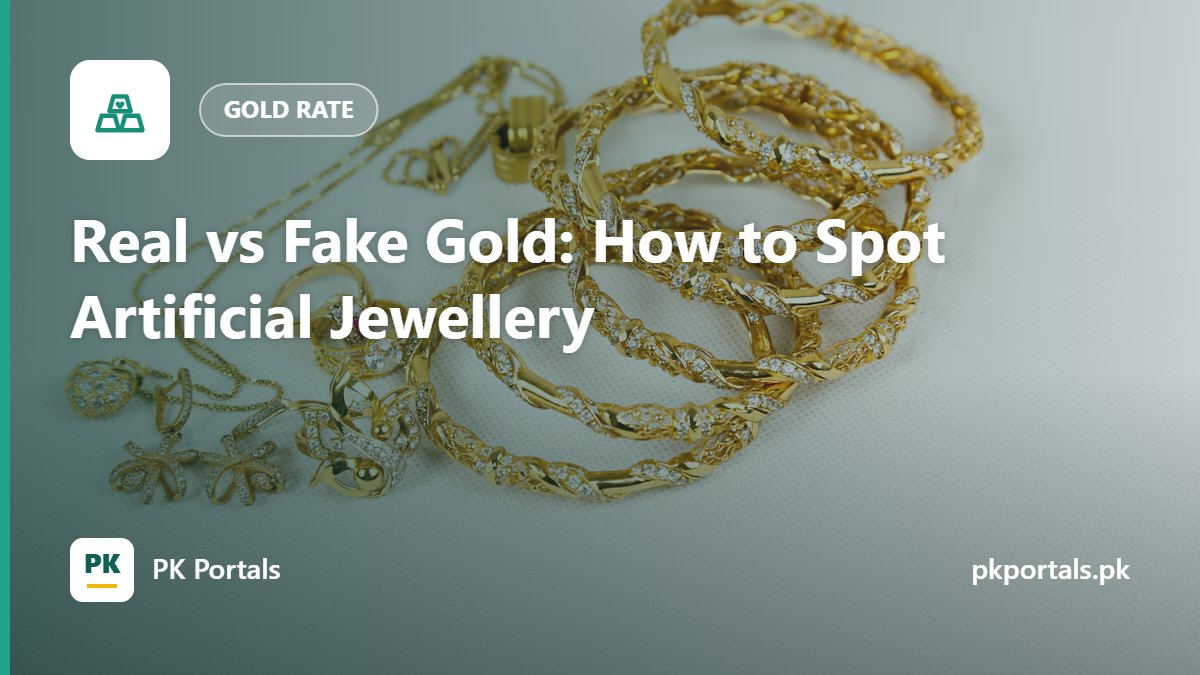
Real vs Fake Gold: How to Spot Artificial Jewellery
Knowing how to identify real gold protects you from paying gold prices for gold-plated or artificial jewellery. Simple home checks such as looking for stamps, a magnet test and watching for skin discolouration can expose obvious fakes, but only a professional test can confirm the exact purity. This guide explains what each check can and cannot tell you, and when to take a piece to a testing lab.
PK Portals is an independent information site and is not linked to any jeweller, testing lab or sarafa association. Home checks are only a first screen; for valuable items, ask for a karat test at an established testing service in your city’s sarafa market and keep the written result.
Quick facts
| Item | Details |
|---|---|
| Real gold | Pure gold (24K) or a gold alloy such as 22K, 21K or 18K |
| Artificial jewellery | Base metal such as brass or copper, often with a thin gold coating |
| Plated marks to watch for | GP, GEP, HGE, RGP, GF |
| Common purity stamps | 999, 916, 875, 750 |
| Magnetic? | Gold is not magnetic |
| Density of pure gold | About 19.3 grams per cubic centimetre |
| Most reliable checks | Karat meter (XRF), acid or touchstone test, fire assay |
Real gold vs artificial jewellery: the main types
| Type | What it is | Contains real gold? |
|---|---|---|
| Solid gold | Gold alloy all the way through | Yes, at the stated karat |
| Gold-plated (electroplated) | Thin gold layer bonded onto brass, copper or silver | Very little, only the surface layer |
| Gold-filled or rolled gold | Thicker gold layer pressure-bonded to a base metal | A small share by weight |
| Artificial or imitation | Base metal or alloy with gold colour or coating | No, or almost none |
| Gold-coloured steel or brass | Coloured metal with no gold layer | No |
Artificial jewellery is perfectly fine to buy when it is sold honestly at artificial prices. The problem arises only when plated or low-purity items are passed off as solid gold.
How to identify real gold at home
1. Look for stamps and markings
Check clasps, the inside of rings and the backs of earrings for purity marks. Numbers such as 916 (22K), 875 (21K) or 750 (18K) indicate the claimed purity. Letters such as GP (gold plated), GEP (gold electroplate), HGE (heavy gold electroplate), RGP (rolled gold plate) or GF (gold filled) mean the item is not solid gold. A missing stamp does not prove an item is fake, since many pieces sold in Pakistan carry no stamp, and a stamp can also be faked.
2. Try the magnet test
Gold is not magnetic. If a strong magnet pulls the item firmly, it contains iron, nickel or another magnetic metal and is not solid gold. However, many fake pieces are made of brass or copper, which are also non-magnetic, so passing this test does not prove the item is real. Clasp springs may contain steel, so test the main body of the piece.
3. Check for wear and colour changes
Look closely at edges, clasps and areas that rub against skin. If a different coloured metal is showing through, the piece is likely plated. Green or black marks on the skin can point to copper or other base metals, although some lower-karat gold alloys can also leave marks on certain skin types.
4. Compare weight and feel
Gold is a very dense metal, so a solid gold piece usually feels heavy for its size. This is only a rough guide, as modern hollow designs are light and some base metals are fairly heavy. Home density tests using water are not accurate enough for small jewellery.
5. Avoid scratch and chemical tests at home
Scratching a piece on unglazed ceramic or using acids at home can damage jewellery and give misleading results, especially on plated items. Leave these tests to a jeweller or lab.
Professional ways to identify real gold
| Test | How it works | Damages the item? |
|---|---|---|
| Karat meter (XRF) | X-rays measure the metals on the surface | No |
| Touchstone and acid | Item is rubbed on a stone and the streak is tested with acids | Leaves a small mark |
| Electronic gold tester | Measures how the metal conducts electricity | No, but less precise |
| Fire assay | A sample is melted and refined to measure gold content | Yes, used mainly for bullion |
For anyone wondering how to identify real gold with certainty, a professional test is the answer. A karat meter is quick and non-destructive, which is why many testing services use one. It reads the surface, so thick plating can sometimes mislead it. For a high-value item or a dispute, a test that looks below the surface, such as touchstone and acid testing or a fire assay, is more reliable. Our gold purity checking guide explains these options in more detail.
Warning signs when buying gold
Knowing how to identify real gold also means spotting warning signs during the sale itself.
- Price well below the day’s rate. Genuine sellers do not sell gold far below the sarafa rate. See gold price per gram in Pakistan to check a quote.
- No receipt or a vague receipt. A proper receipt states the karat, weight, rate and making charge.
- Pressure to decide quickly. Street sellers, online deals and unknown sellers claiming an emergency sale are higher-risk situations.
- Unusually light weight for the design. Ask whether the piece is hollow or contains wax or filler.
- Unclear stone weight. Stones, lac or filler should not be charged at the gold rate.
What to do if you suspect fake gold
- Stop before paying. Ask the seller for a karat test at an independent lab of your choice.
- Keep all paperwork. Retain the receipt, the shop’s name and address, and any test report.
- Return to the seller first. Show the test result and ask for a refund or exchange.
- Seek help. If the seller refuses, you can seek help through the consumer protection system in your province. Keep records and avoid confrontation.
When selling or exchanging, jewellers test purity before making an offer, so a low-purity item will be valued lower. See our guides on selling gold in Pakistan and tezabi gold for how purity affects price.
Related guides
- How to check gold purity at home
- 24K vs 22K vs 21K gold: difference, purity and price
- 18K gold: purity, price and where it is used
- Tezabi gold meaning
- Gold price per gram in Pakistan: how to work it out
- Selling gold in Pakistan: kaat deduction
Frequently Asked Questions
How can I identify real gold at home?
Look for purity stamps, check that a magnet does not attract it, and inspect worn areas for a different metal underneath. These checks can expose obvious fakes, but only a professional karat test confirms purity.
Does real gold stick to a magnet?
No. Gold is not magnetic. If an item is strongly attracted to a magnet it is not solid gold, but a non-magnetic item may still be fake.
What does 916 mean on gold?
The 916 stamp indicates 22K gold, meaning about 91.6 percent gold content. It is a claim of purity and can be confirmed with a karat test.
Can a gold tester be fooled?
Surface testers such as karat meters can occasionally be misled by thick plating. For high-value pieces, a jeweller can use a touchstone and acid test, or a sample can be assayed.
Is gold-plated jewellery worth anything when sold?
Very little as gold, because the gold layer is extremely thin. Jewellers value it as base metal or decline to buy it.